
What the Display Shows When Messages Stop
Filed under: Workshop Notes
A display can retain a plausible value after the message carrying it has stopped arriving. For a networked workshop project, that creates a useful design question: how will someone distinguish the last received value from a newly received one?
Raspberry Pi’s November 6, 2026 iroh announcement describes a port to RP2350 and a demonstration using a Pimoroni Presto with Wi-Fi. This is a dated account of a particular implementation. It gives a group a reason to investigate communication states, without assuming that every board or every transport has the same capabilities.
Define freshness as part of the behaviour
For a small display-only exercise, give each generated message a sequence number. Record the number alongside the displayed value. The number is useful because a value can remain unchanged even while new messages continue to arrive.
Then decide what the demonstration should show when expected messages stop. A retained value could remain visible with an explicit last-update indicator. Alternatively, the display could replace it with an unavailable state. Choose an arrangement that a participant can explain, and write its rule down before testing.
A connection indicator and a newly received application value describe different events. Name the evidence the display rule uses: an accepted message, its identity and a checkpoint at which a newer message was expected.
Rehearse the missing message on paper
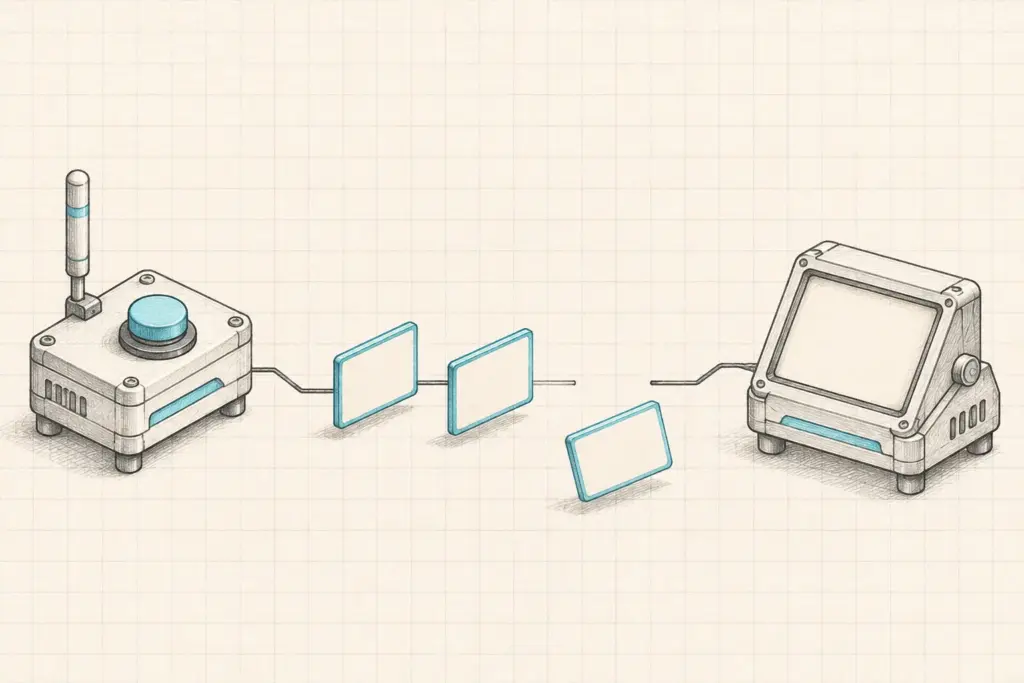
Use cards before adding hardware. One person is the sender, another is the display, and a third keeps the event record. Give the display a written rule for three situations:
- A new numbered message arrives.
- No message arrives at a previously agreed check point.
- An older message arrives after a newer one.
In the final situation, ask the group to explain whether an earlier value should replace the later one. The exercise makes ordering assumptions visible. It does not require a shared clock, because the participants can follow the numbered message order in their written scenario.
Repeat with the same cards in a different arrival order. Then discuss a sender restart separately: if numbering starts again, the rule needs a way to distinguish the new run from an old message. Record the displayed value and status after each event. If two people applying the same rule produce different results, clarify the rule before treating it as a software requirement.
Work through one invented event log
For this paper example, identify each message by a run letter and sequence number. Accept only increasing numbers in the declared current run. An older or wrong-run message leaves the last accepted receipt unchanged. At the agreed checkpoint, no new accepted message means the retained value is marked stale. A participant must declare a restart before the new run is accepted.
| Event | Display and receipt after the event |
|---|---|
| A/1, value 17 | 17; fresh, last receipt A/1 |
| A/3, value 17 | 17; fresh, last receipt A/3 |
| Late A/2, value 19 | Keep 17 and receipt A/3; no freshness update |
| Checkpoint with no newer accepted message | Keep 17; mark stale |
| Declared restart, then B/1, value 8 | 8; fresh, last receipt B/1 |
| Late A/4, value 22 | Keep 8 and receipt B/1; old run ignored |
The unchanged 17 in the second row is still new information about receipt. The late 19 is not. These invented events specify one classroom policy; they are not measurements of iroh or a claim about its packet format, delivery guarantees or security.
Transfer only the question you tested
The card exercise helps specify desired application behaviour. It does not measure a network’s reliability, establish a timeout for every use case or test the security of the implementation described in the announcement.
When a group moves to an existing hardware demonstration, it can compare the real event record with the agreed display rule. Keep the exercise limited to showing information. Controlling a moving mechanism would introduce additional questions that this activity has not examined.
A useful closing explanation includes the last successful message and the state that followed its absence. The demonstration becomes easier to understand when losing communication is something the group can describe as clearly as receiving it.