
When Zero Wind Means a Stalled Rotor
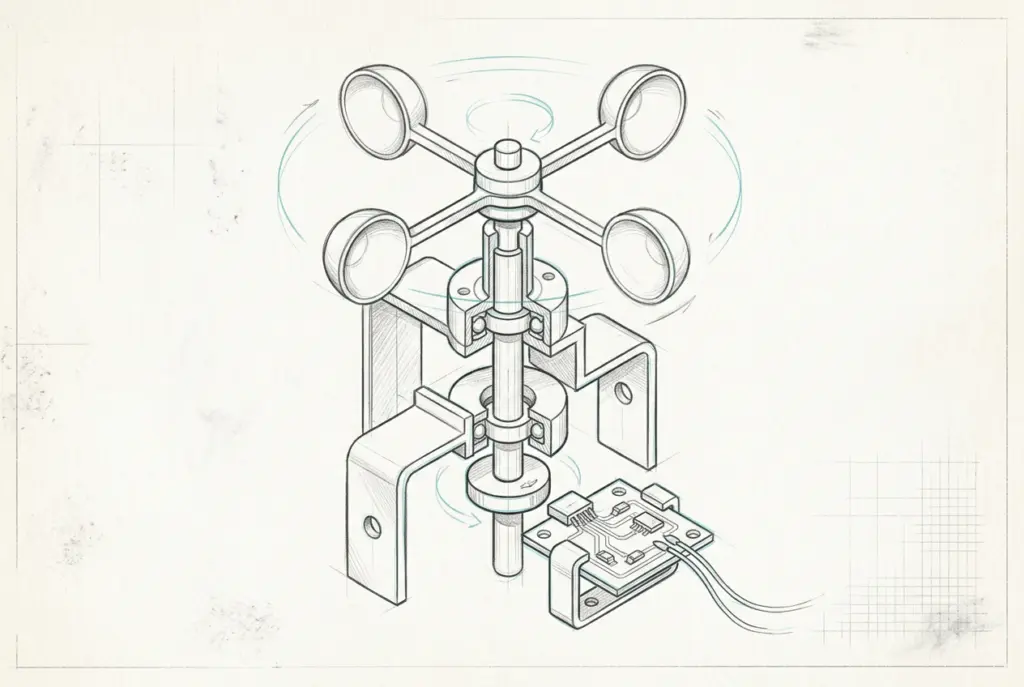
A weather station that reports zero wind gives a robotics group a useful question: did the air stop moving, or did the measuring mechanism stop responding? In Jack Young’s portable weather station, bearing friction made that distinction matter. The practical lesson is to observe the movement that produces a reading before trusting the reading alone.
The Raspberry Pi account of Young’s mobile weather station describes a modular, solar-powered device built around a Raspberry Pi Zero W. Its sensors cover temperature, humidity and wind speed, while its solar panel also provides a light-intensity measurement. For a workshop, the wind mechanism offers a manageable piece of that larger system to investigate.
Follow the movement into the measurement
The anemometer uses a magnet and a Hall effect sensor to measure rotational speed. The useful chain to draw is air movement, rotor movement, magnet passage, then recorded rotation. Each step gives the group something different to inspect. A recorded zero describes the end of that chain; it does not, by itself, explain what happened earlier.
During testing on the Gower Peninsula near Swansea, the creator found that friction in the bearings could stop the rotor at slower wind speeds. The station then returned zero. Lubricating the bearings improved its operation. That is a reported finding from this particular build, rather than evidence that every zero from every anemometer has the same cause.
Ask the group to sketch the rotor, its support, the magnet and the sensor. Beside the sketch, record two separate observations: whether the rotor visibly moves and whether the electronics register movement. Keeping those observations separate helps the group explain a fault without jumping straight to a software change.
A small experiment: does the rotor need help to start?
The following is a proposed workshop investigation, not a procedure reported in the source. Its testable question is: under the same fan setting and placement, does a stationary rotor behave differently from one given a gentle starting turn?
- Secure a small anemometer assembly in a fixed position relative to a fan. Keep the fan setting, distance and rotor orientation unchanged throughout a comparison.
- With the rotor initially still, switch on the fan. Observe whether rotation begins and whether the sensor records it.
- Repeat under the same conditions, this time giving the rotor a gentle starting turn and moving your hand clear before observing it.
- Repeat both conditions several times. Record visible movement and sensor output separately, including any disagreement between them.
- If appropriate maintenance is available for the bearing assembly, repeat the comparison after maintenance and document exactly what changed.
Choose an observation interval before starting and use it consistently. Assign one participant to watch the mechanism and another to record the output. Have the group write its prediction first: will the rotor start unaided, keep moving only after a nudge, or stop in both conditions?
If the rotor repeatedly stays still from rest but continues turning after a nudge, that result supports investigating resistance to starting. If it visibly turns while the output remains zero, inspect the sensing and recording stages next. These are suggested diagnostic decisions; the source supplies no results for this proposed comparison.
Keep the claim smaller than the experiment
A fan comparison cannot establish accurate wind speed, outdoor performance or a calibrated starting threshold. The supplied account gives no reference wind measurements or detailed calibration method. A change after bearing maintenance would also need careful interpretation if the assembly’s alignment or placement changed at the same time.
The temperature findings reinforce the need for this restraint. Young reported readings roughly 1–2°C above expectations and suggested heat trapped around the sensor as a possible cause. That explanation remains tentative in the supplied account. A group should preserve the distinction between an observed discrepancy and its proposed cause.
The enclosure likewise went through repeated revisions aimed at an IP65 target, with attention to gaskets and cable entries. The excerpt does not provide independent ingress-test evidence. For the workshop record, finish with a narrow decision supported by observations: which stage should the group inspect next, and what additional measurement would justify changing the design?